
Goldendoodles and Kids: A Breeder’s Guide to Safe Boundaries
Looking for the specific tools I use with Charlie? Check out my Master Gear Page for my top-rated Goldendoodle supplies, from grooming tools to training crates.
The image of a fluffy Goldendoodle puppy cuddled up with a toddler is the "dream" for many families. As a professional breeder, I know that Goldendoodles have the potential to be incredible companions for children, but as a trainer, I have to be the one to say it: The "puppy" stage is not a fairytale. When people ask if Charlie is good with kids, my answer is always: "He is as good as the boundaries we set for him." If you are a parent looking for a "nanny dog" that will just tolerate being pulled and poked, you are looking for a unicorn. Here is the honest reality of raising a Mini Goldendoodle around children and why I am so protective of Charlie’s space.
The "Land Shark" vs. The Toddler
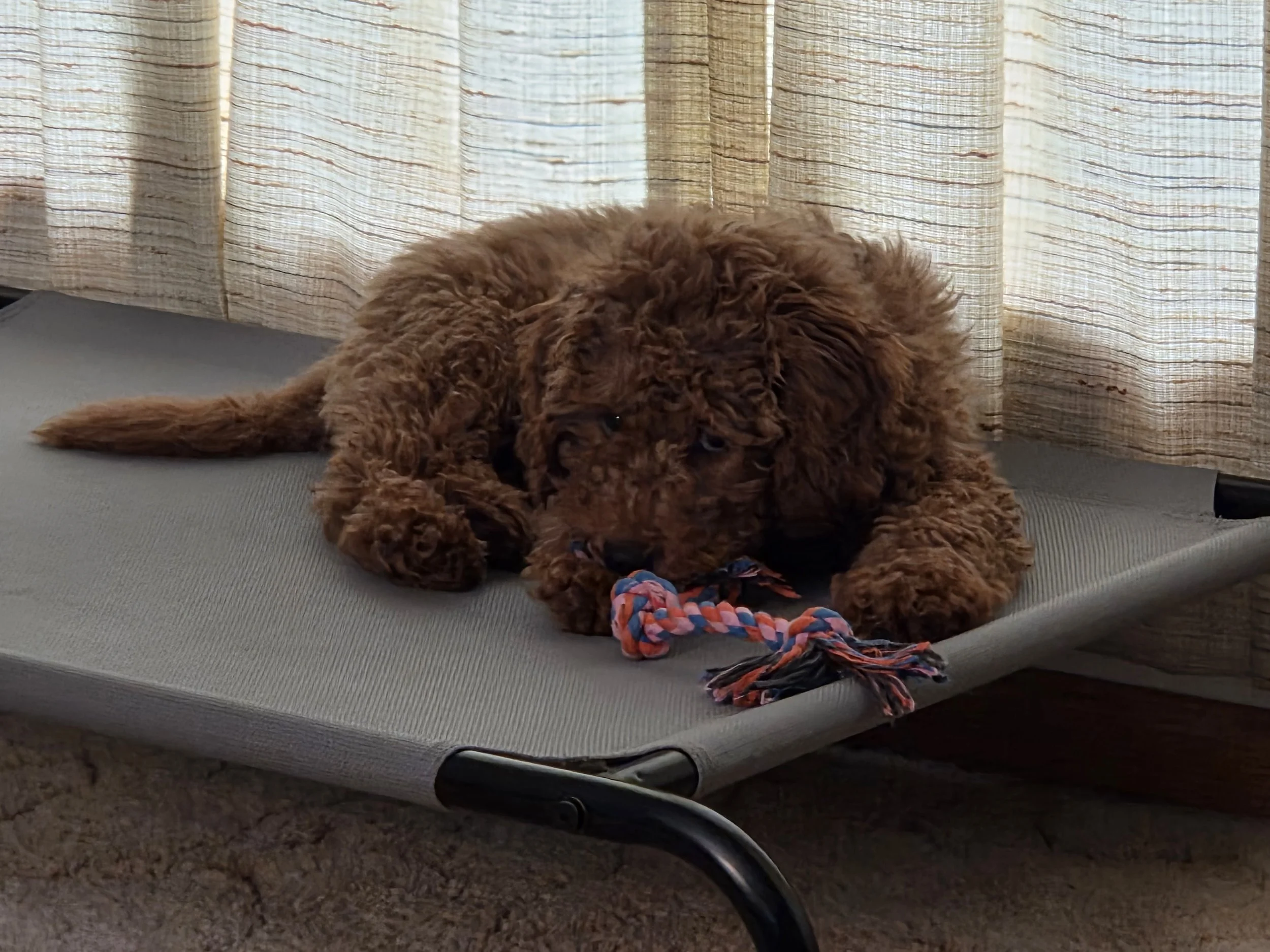
At 13 weeks old, Charlie is in the height of his teething phase. In my guide on Why Goldendoodles Aren't for Everyone, I mentioned the high-energy Poodle brain. That brain, combined with "needle teeth," means Charlie’s first instinct is to nip at anything that moves quickly—including a child’s heels or hands.
If you have young children, you must realize that a Goldendoodle puppy doesn't see a toddler as a "master"; they see them as a littermate. This leads to jumping, nipping, and accidental knock-downs. If you aren't prepared to supervise every single interaction, you might be in for a stressful first year.
Setting the "Puppy Zone" Boundaries
In an apartment or a large house, the strategy is the same: Separation is the key to success. Charlie has a dedicated "Puppy Zone" (usually his playpen or a gated-off room) where the kids are not allowed to go. This gives Charlie a safe place to retreat when he is overwhelmed.
Most bites or nips happen when a puppy is cornered or over-stimulated. By teaching children that the puppy's crate and pen are "off-limits," we prevent 90% of potential issues. This is especially important in smaller homes where space is tight, as I discussed in Doodles in Apartments.
Training the Kids, Not Just the Dog
I tell all my Ironstone families that the children need more training than the puppy.
Be a Tree: I teach kids that if Charlie gets too "mouthy" or jumpy, they should stand perfectly still, fold their arms, and look at the sky. Movement triggers Charlie’s prey drive; being a "tree" makes him bored.
No "Ground Level" Play: For the first few months, I don't let children sit on the floor with Charlie. Being at eye level makes the child a target for face-licking and nipping.
The "Two-Hand" Rule: If a child wants to pet Charlie, they must use one hand to pet his side (never his head) and have the other hand at their side. This prevents the "poking" that leads to defensive behavior.
The Reality of Multiple-Pet Homes
If you are adding a Goldendoodle to a home that already has children and other pets, the "chaos factor" is real. I’ll be diving deeper into this in my next article on [Multiple Dog Households], but for now, remember that your attention will be split. A Goldendoodle requires a lot of "eyes-on" management. If you are already stretched thin by your children's schedules, adding a high-maintenance Doodle might be the tipping point.
Final Thoughts
Goldendoodles can be the best friend your child will ever have, but they aren't "pre-programmed" to be perfect. Charlie is a wonderful boy because he knows the rules and his boundaries are respected. If you are willing to do the work to train both your kids and your pup, the bond is worth it. But if you're looking for an "easy" addition to a chaotic house, please think twice before bringing a Doodle home.