
How to Stop Your Goldendoodle from Jumping: The 'No-Jump' Greeting Guide
Looking for the specific tools I use with Charlie? Check out my Master Gear Page for my top-rated Goldendoodle supplies, from grooming tools to training crates.
If coming home feels like entering a wrestling match with a fluffy pogo stick, you have a Goldendoodle that lacks "Greeting Impulse Control."
In the doodle world, we often joke about the "Doodle Bounce," but in reality, a 50-lb dog jumping on a child or an elderly guest is no laughing matter. As an IACP-certified trainer, I see jumping as a symptom of a dog that hasn't learned how to manage their excitement.
In this guide, I’m showing you why your dog jumps and the exact "Four on the Floor" protocol I use to ensure every greeting is calm and respectful.
1. The Biology of the "Vertical Greeting"
Dogs naturally greet each other face-to-face (or nose-to-nose). Because we are much taller than them, their instinct is to close the gap.
The "Poodle Pop": Poodles are naturally athletic and springy. They find vertical movement easier than many other breeds.
The Social Drive: Unlike some breeds that are indifferent to strangers, Goldendoodles view every person as a potential best friend.
Accidental Reinforcement: If you pet your dog, talk to them, or even push them away while they are jumping, you have just "paid" them for the behavior. To a Doodle, even a "No!" is a form of attention.
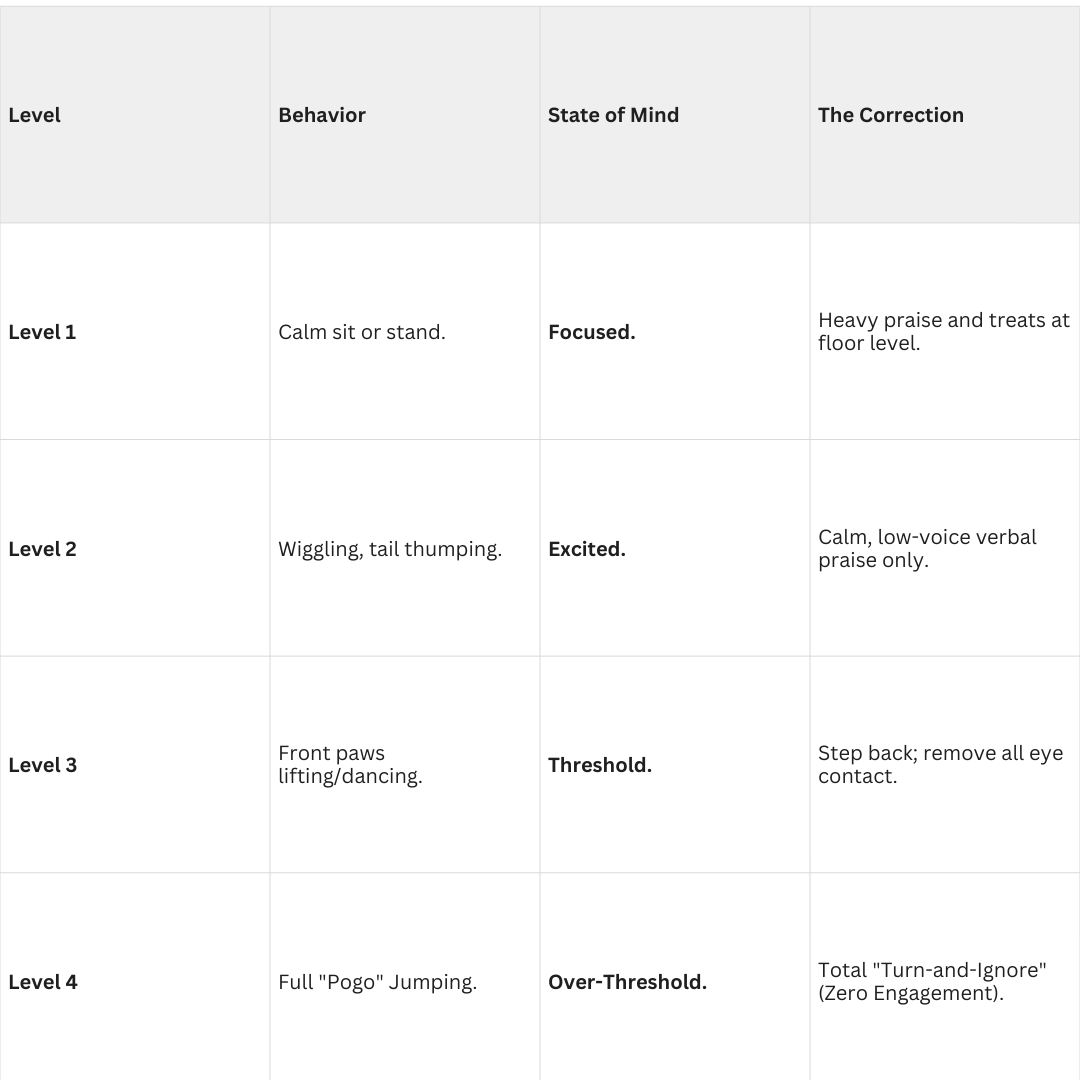
2. The Greeting Intensity Scale
Not all jumps are created equal. Use this scale to identify where your dog's impulse control is breaking down.
3. The "Zero Engagement" Rule
The hardest part of training a "No-Jump" greeting is training the humans. To stop the jump, you must become the most boring thing in the room the moment those paws leave the floor.
The Protocol:
Turn Your Back: The moment the paws touch you, turn 180 degrees and cross your arms. No "Off," no "No," no eye contact.
Wait for the "Drop": The second all four paws are back on the floor, count to three.
Reward Low: Bend down and reward the dog on the floor. If you reward them while you are standing tall, you are encouraging them to reach back up.
4. Advanced Redirection: The "Hand Magnet" Greeting
One of the best ways to stop jumping is to give the dog a different job to do. This is where we use the Hand Magnet Mastery we covered in Article #1.
By presenting your hand low (at the dog's nose level) as you enter the house, you "lock" their nose to your hand. A dog that is focused on following a hand magnet to a "Sit" position physically cannot jump at the same time.
5. Managing Guests (The Ultimate Test)
Your dog might listen to you, but they will still jump on guests because guests are "new and exciting."
The "Tether" Method: Keep your puppy on a leash when guests arrive. Step on the leash so the puppy only has enough slack to sit or stand, but not enough to jump.
The "Toy Trade": As we discussed in The Redirection Chapter, having your dog find a toy to hold in their mouth during a greeting can lower their arousal levels significantly. A dog with a mouth full of a stuffed duck is less likely to use that mouth to nip or that body to jump.
Build the "Polite Doodle": Join the Academy
Jumping is a habit that gets stronger every time it's successful. If you want a dog that guests actually enjoy visiting, you need to move beyond "stopping the jump" and start "teaching the sit."
Inside the Ironstone Goldendoodle Academy, I have a dedicated section on Impulse Control. I show you the exact "Leash-Stepping" drills and "Guest Greeting" protocols I use to proof these behaviors in the real world.
Turn that pogo stick into a polite companion.