
Tether Training for Puppies: Why Charlie is Always on a Leash
Looking for the specific tools I use with Charlie? Check out my Master Gear Page for my top-rated Goldendoodle supplies, from grooming tools to training crates.
One of the biggest mistakes I see new puppy owners make is giving their Goldendoodle too much freedom, too soon. They bring a 10-week-old puppy home and let them roam the living room while they watch TV or fold laundry. Ten minutes later, they find a puddle on the rug or a chewed-up baseboard.
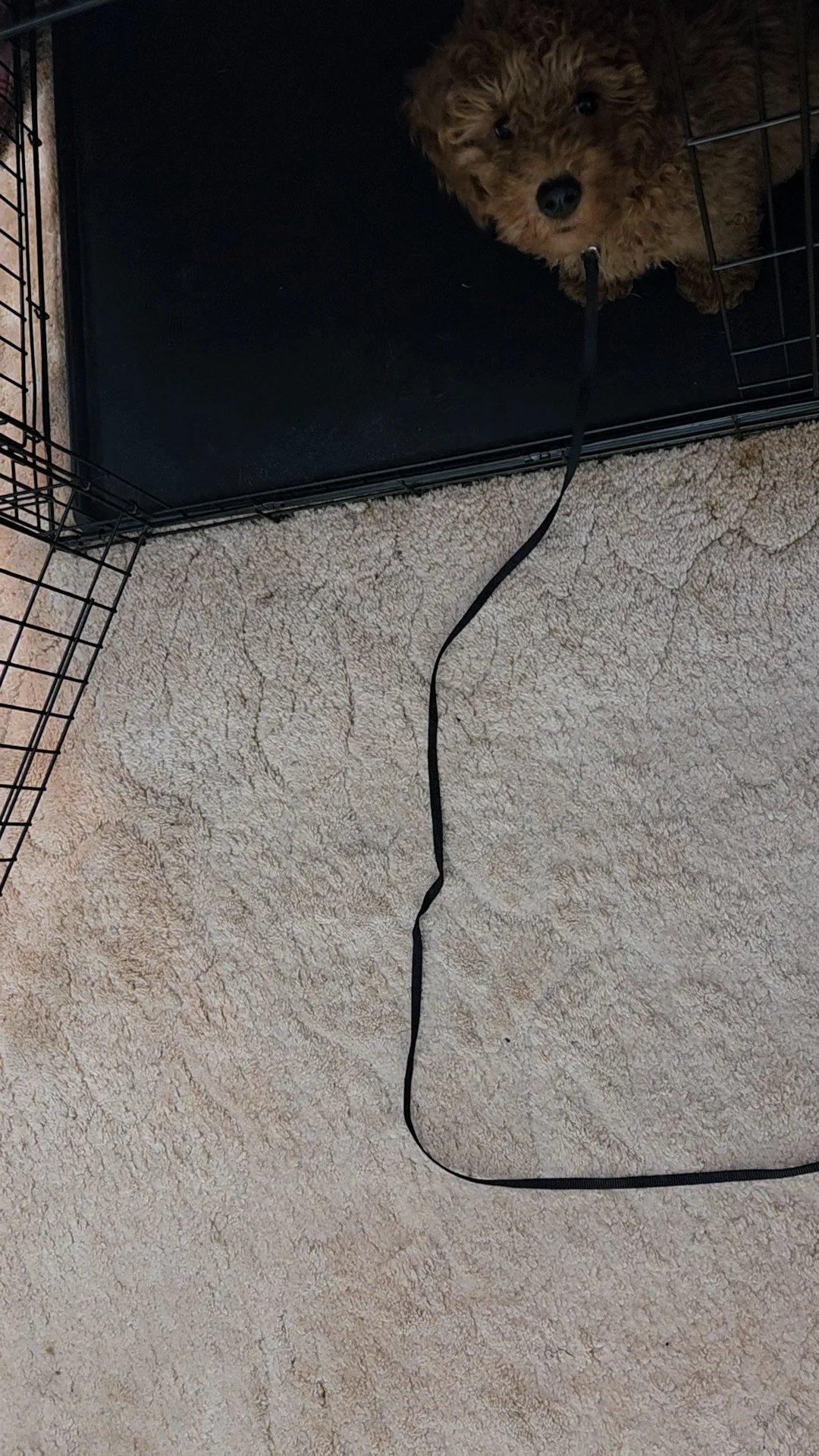
When people visit my home and see Charlie, they often ask, "Why is he on a leash while you're just sitting at your desk?" The answer is simple: Tether Training. At 13 weeks old, Charlie is a "Land Shark" in training, and tethering is my #1 tool for preventing bad habits before they even start.
What is Tether Training?
Tether training (sometimes called "Umbilical Cord Training") is the practice of keeping your puppy attached to you or a heavy piece of furniture via a 4-to-6-foot leash.
As a professional breeder, I know that Goldendoodles are incredibly social. They want to be near you. Tethering uses that natural desire to your advantage. It creates a "boundary of success" where Charlie is physically unable to get into trouble, which allows me to focus on my work while he learns how to settle.
Why I Don't Give Charlie "Free Roam" Yet
Freedom is something a puppy earns through consistent good behavior. If I let Charlie roam free right now, I’m essentially gambling with my house.
Potty Training Accuracy: If Charlie is tethered to me, I feel him "circle" or get restless the second his bladder is full. I can catch him before the accident happens.
Destructive Chewing: He can’t sneak off to chew the corner of the sofa or a stray power cord if he’s only 4 feet away from me.
The "Velcro Dog" Habit: It reinforces the idea that being near me is the most rewarding place to be. This pays off massively later when we start working on off-leash reliability.
How to Set Up a Tether Station
I don't just hold the leash all day. I’ve set up "Tether Stations" in the rooms where I spend the most time—my office and the kitchen.
The Gear: I use a lightweight, chew-proof coated cable or a sturdy nylon leash. You want something that won't get tangled easily. I’ve linked the exact "House Leashes" I use for Charlie on my Gear Page.
The Anchor: I loop the leash around the leg of my heavy oak desk or use a dedicated floor anchor.
The Reward: The tether is never a punishment. When Charlie is on his tether, he gets a high-value chew toy or a stuffed Kong. This teaches him that being "tethered" means it’s time to relax and enjoy a snack.
Transitioning to "The Settle"
The ultimate goal of tether training is to teach Charlie an "Off Switch." Mini Goldendoodles are high-energy dogs. If they aren't taught how to be bored, they will find their own (usually destructive) ways to entertain themselves.
Because Charlie has spent hours on a tether at my feet while I work, he has learned that when the leash is on, the "party" is over. He now naturally lies down and sighs the moment I clip him in. This is "Calmness Training," and it is the foundation of a dog you can actually take to a brewery or a coffee shop later in life.
Avoiding the "Puppy Burnout"
Many owners find themselves constantly hovering over their puppy, yelling "No!" every thirty seconds. That is exhausting for you and confusing for the dog. Tethering removes the need for 90% of those "No's." If Charlie can't reach the shoe, I don't have to tell him not to chew it.
I’ve dedicated a deep-dive lesson to "Passive Training and Management" in the Puppy Foundations module of my Goldendoodle Academy. For $45, I show you how to set up your home so that your puppy "trains themselves" while you go about your day. It’s the difference between a stressful puppy experience and a professional one.
Mastering the 'Settle' on a tether makes my job much easier when we go out in public. It’s the secret to the calm behavior I show in my guide to Socializing Charlie Safely in Public.
Final Thoughts
Charlie won't be on a leash in the house forever. But by using a tether at 13 weeks, I’m ensuring that when he is finally given free roam, he’ll have the maturity and habits to handle it. If you’re tired of playing "detective" to find where your puppy hid to pee, clip them to your belt or your desk today. It’s a game-changer!