
The Ultimate Goldendoodle Growth Guide: Predicting Your Puppy’s Adult Size
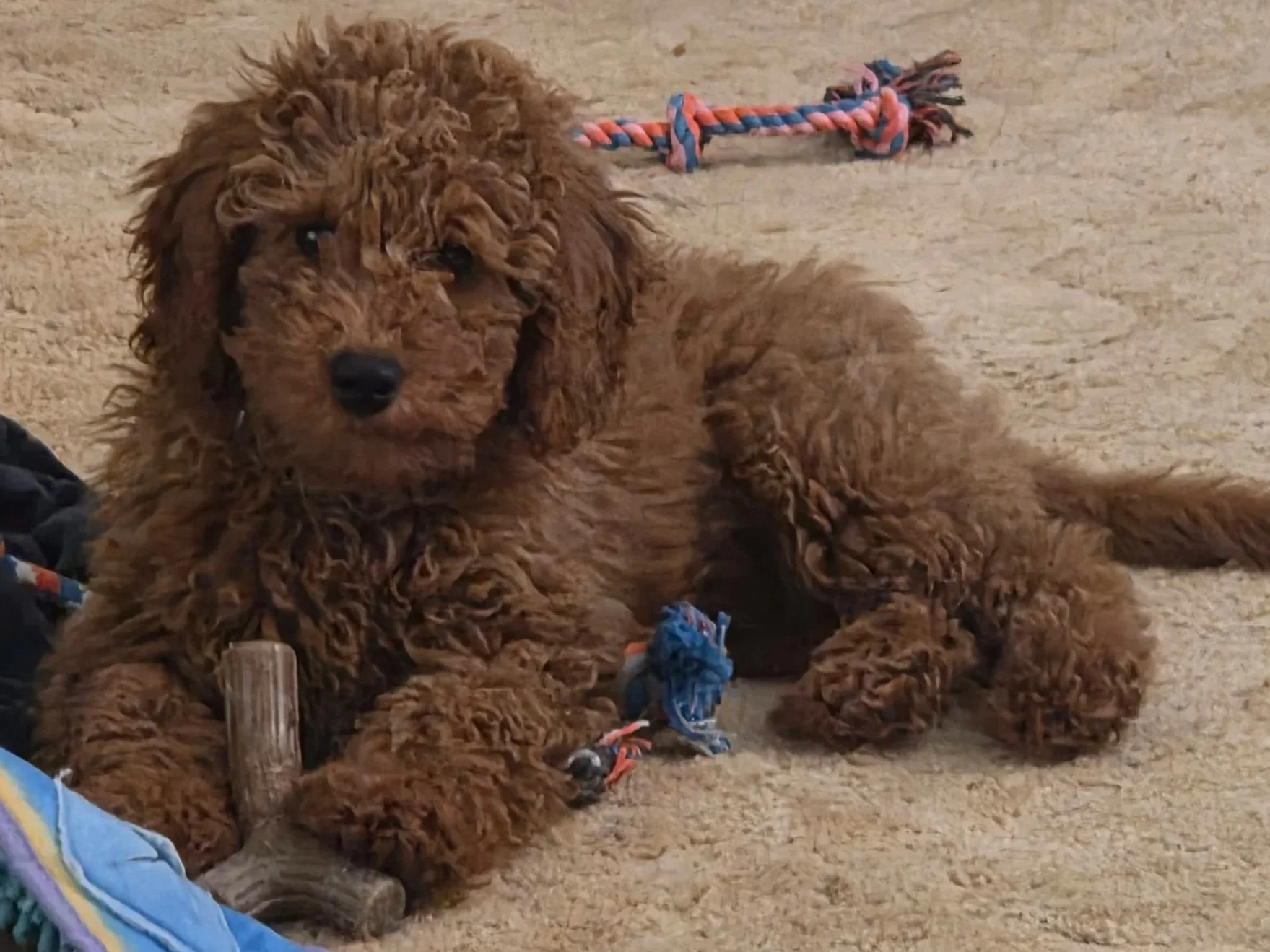
Looking for the specific tools I use with Charlie? Check out my Master Gear Page for my top-rated Goldendoodle supplies, from grooming tools to training crates.
If you’ve spent any time on Reddit or Facebook dog groups lately, you’ve seen the panic: "My 4-month-old Mini is already 20 pounds—is he actually a Giant?"
Because Goldendoodles are a crossbreed, their growth isn't as predictable as a purebred Labrador or Poodle. Factors like "generation" (F1 vs. F1b) and the height of the parents play a massive role. As an IACP-certified trainer and GANA-affiliated breeder, I’ve tracked the growth of dozens of puppies, including our own Charlie and Phoebe, to find the science behind the "Doodle Curve."
This guide will show you exactly how to read the milestones, use the "Puppy Math" formulas, and know for sure which GANA size category your dog actually falls into.
The GANA Size Standards: Petite, Mini, Medium, or Standard?
The Goldendoodle Association of North America (GANA) sets the industry standard. While most people focus on weight, GANA primarily categorizes by height at the withers (the highest point of the shoulder).
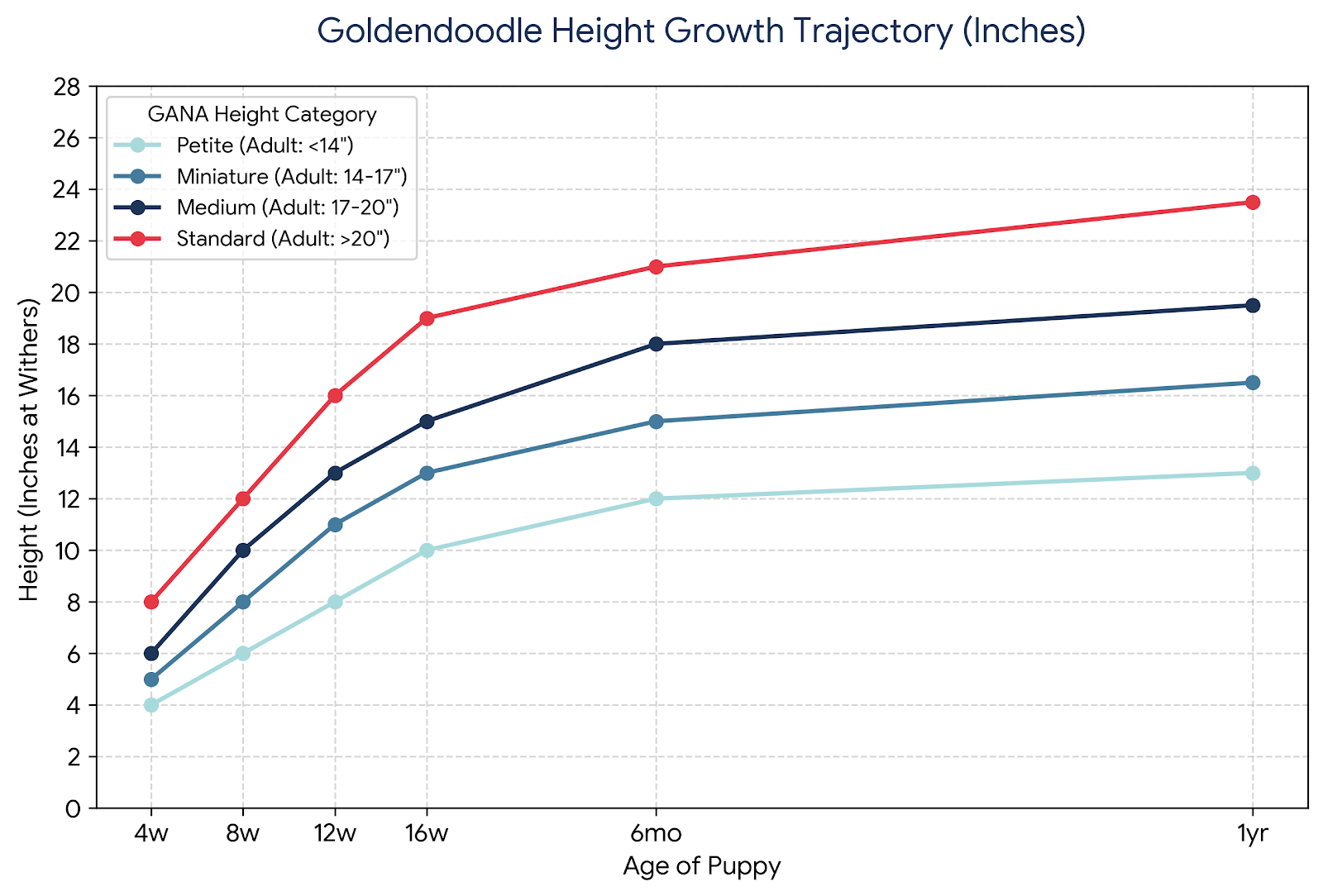
Goldendoodle Height Chart
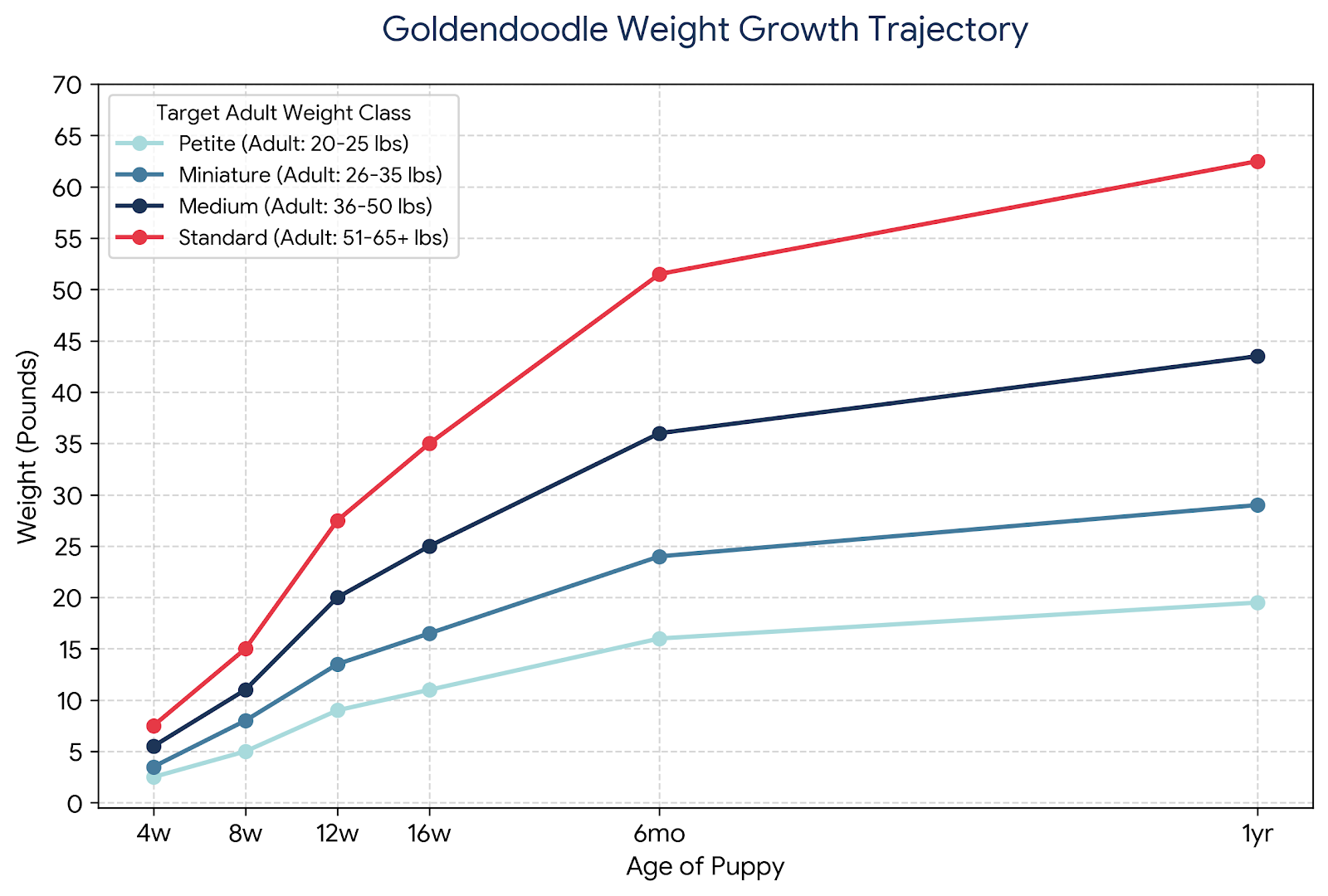
Goldendoodle Weight Chart
Predicting the Future: The "Puppy Math" Formulas
You don't need a crystal ball to know if your puppy is on track. There are two proven methods we use at Ironstone Goldendoodles to estimate adult size.
Method A: The 16-Week (4-Month) Rule
For the vast majority of Goldendoodles, their weight at exactly 16 weeks is roughly 50% of their adult weight.
Formula: (Weight at 16 weeks) x 2 = Estimated Adult Weight.
Example: If your puppy is 15 lbs at 4 months, they will likely settle around 30 lbs—a perfect Miniature.
Method B: The 8-Week Multiplier
If you just brought your puppy home and can’t wait 4 months, take their 8-week weight and multiply it by four.
Formula: (Weight at 8 weeks) x 4 = Estimated Adult Weight.
Note: This works best for Petite, Mini, and Medium varieties.
The "Doodle Curve" Trajectory
Goldendoodles don't grow in a straight line; they grow in a curve. Most of the heavy lifting happens in the first six months.
The Three Phases of Growth:
The Sprint (0–4 Months): This is rapid-fire development. Your puppy will reach nearly half their adult weight in this window.
The Steady Climb (5–9 Months): Weight gain slows down, but this is where Adult Height is established. Your dog might look "leggy" or awkward during this phase.
The Fill-Out (10–18 Months): They’ve stopped getting taller, but they are gaining muscle and their adult coat is fully maturing.
Why Height and Neck Measurements Matter
Most owners only look at the scale, but at Ironstone, we track height and neck size too.
Height tells us if they are hitting the GANA standard category.
Neck size is a vital safety metric for training gear transitions and monitoring "coat funk" (when the hair makes them look bigger than they physically are).
Stop Guessing—Start Tracking Like a Pro
If you’re tired of generic charts and want to know exactly how your puppy compares to the GANA standards, I’ve put together the same tool I use in my own breeding program.
The Ironstone Goldendoodle Growth & Milestone Workbook

Stop wondering how big your puppy will get and start tracking with professional precision. Created by an IACP-certified trainer and GANA-affiliated breeder, this 19-page digital workbook is the ultimate companion for every Goldendoodle owner.
Whether you are trying to predict your puppy's adult weight or ensuring they hit their physical milestones, this guide provides the real-world data you need. Unlike generic online charts, this workbook uses the official GANA (Goldendoodle Association of North America) size standards for Petite, Miniature, Medium, and Standard Goldendoodles to give you accurate height and weight projections.
What’s Included:
Interactive Growth Logs: Custom-designed tables to track your puppy’s weight, height, and neck measurements week-by-week.
Scientific Weight Projections: Learn the "4-Month Rule" and "Puppy Math" formulas to estimate your dog's adult size with confidence.
Visual Growth Trajectories: High-resolution charts showing the "Doodle Curve" for both height and weight development.
The 'Big World' Socialization Checklist: A 10-point roadmap to ensure your puppy grows into a confident, well-adjusted adult.
Developmental Milestones: Month-by-month breakdowns of teething, coat transitions, and critical training goals.
Health and Joint Safety During Growth
Because Goldendoodles are active, "high-drive" dogs, their growth needs to be managed.
The Lean Rule: You should be able to feel your puppy's ribs easily but not see them. Growing too fast can lead to joint issues like hip dysplasia.
Growth Plates: Avoid long runs on concrete or high-impact jumping until their growth plates close around 12–14 months.
Final Thoughts
Whether you have a 10-pound Petite or a 70-pound Standard, the most important part of the journey is the bond you build. Use these charts as a roadmap, but remember that every dog is an individual.
Want to see these charts in action? Check out our week-by-week case study on Charlie’s Real Growth Journey.