
How to Stop Goldendoodle Leash Biting: The 'Leash Trade' Guide

Looking for the specific tools I use with Charlie? Check out my Master Gear Page for my top-rated Goldendoodle supplies, from grooming tools to training crates.
You’re ready for a nice, relaxing stroll through the neighborhood. You clip on the leash, step out the door, and within ten feet, your Goldendoodle puppy has flipped around and is growling, thrashing, and playing a high-stakes game of tug with their lead.
If you pull back, they pull harder. If you yell, they think you’re "barking" along with the game.
As an IACP-certified trainer, I see this daily. Your puppy isn't trying to be "dominant"—they are simply following their Retriever instinct to carry something in their mouth combined with their Poodle instinct to solve the "puzzle" of the moving leash. In this guide, I’m showing you the "Leash Trade" system to break this habit in seconds.
1. The Biology of the "Leash Grab"
To a Goldendoodle, a leash is not a safety tool; it is a moving target.
Prey Drive Trigger: When the leash dangles and swings near their face, it triggers the same part of the brain that wants to chase a squirrel.
Tug-of-War Instinct: Puppies love "resistance." When they grab the leash and you pull back to get it out of their mouth, you have just started the most fun game of their life.
Overstimulation: Often, leash biting happens at the start of a walk (excitement) or the end of a walk (exhaustion/over-stimulation).
2. The Leash Habit Scale
Identify where your puppy falls on the "Leash Habit" scale to determine which redirection tool you need.
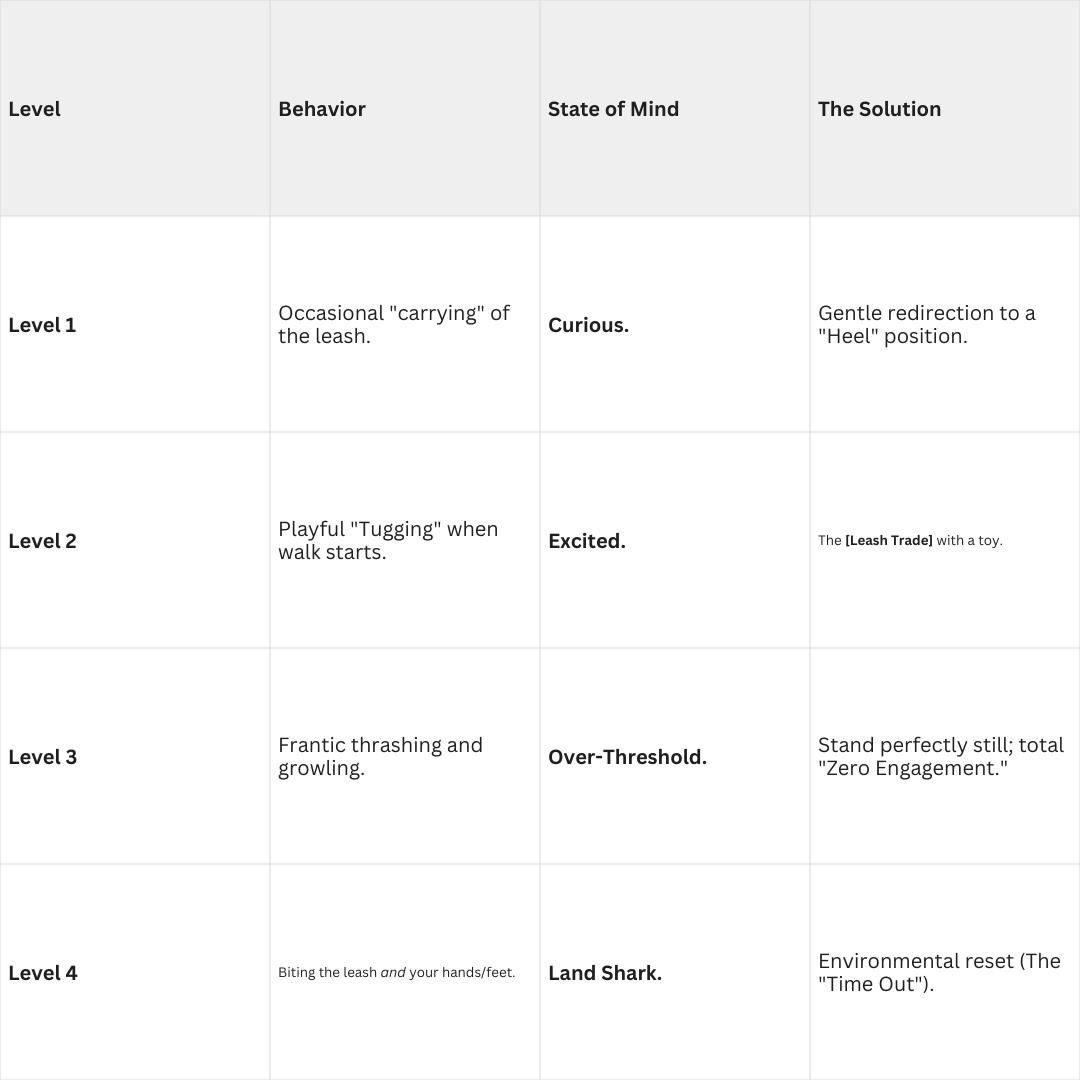
3. The "Leash Trade" Protocol
The goal is to make the leash the most "boring" thing in the world and a designated "leash toy" the most exciting.
Step 1: Be the Statue
The moment your puppy grabs the leash, stop moving. Do not pull the leash. Do not look at the dog. If you provide zero resistance, the "Tug" game dies.
Step 2: The Strategic Swap
Carry a specific, high-value toy (like a soft fleece tug or a braided rope) that they only get during walks. When they grab the leash, present the toy. As seen in my Redirection Lesson, the moment they drop the leash to grab the toy, say "Yes!" and keep walking.
Step 3: The "Two-Leash" Hack
If your puppy is obsessed with the movement of the leash, clip two leashes to their harness. When they grab one, simply drop that lead (it stays attached to the dog) and use the second one. Puppies can't "tug" against a leash that isn't being held by a human.
4. Why Bitter Sprays Often Fail
Many owners try "Bitter Apple" sprays on the leash. While this works for some, many Poodle-mixes actually like the taste or simply ignore it because the "fun" of the game is more powerful than the bad taste. Training the brain is always more effective than masking the tool.
5. Master the Walk: Join the Academy
Leash biting is a symptom of a dog that doesn't yet know how to walk with "Focus." If you want a dog that walks calmly by your side instead of fighting you every step of the way, you need a structured walking plan.
Inside the Ironstone Goldendoodle Academy, I have built a dedicated module in The Redirection chapter specifically for leash management. I show you the exact "Zero Engagement" stance and the "Toy-Trade" timing I use to turn frantic leash-biters into polite walking partners.