

Looking for the specific tools I use with Charlie? Check out my Master Gear Page for my top-rated Goldendoodle supplies, from grooming tools to training crates.
If you feel like you brought home a fluffy crocodile instead of a puppy, you aren't alone. The Goldendoodle "Land Shark" phase is legendary among owners. Because of their unique lineage—combining the mouthy nature of a Retriever with the high-intelligence "problem-solving" brain of a Poodle—Goldendoodle nipping can be more intense than other breeds.
In this masterclass, we will break down the biology of the bite, why "traditional" advice often fails, and the IACP-certified redirection system we use at the Ironstone Academy.
1. The Biology of the Bite: It’s Not Aggression
Before you can fix the behavior, you have to understand that your Goldendoodle isn't being "mean." They are being sensory.
The Poodle Brain: Poodles use their mouths like humans use their hands. They explore textures, shapes, and resistance.
The Retriever Drive: Goldendoodles have an innate "soft mouth" drive that is misaligned in puppyhood. They want to hold things, and your moving hands are the most exciting "toy" in the room.
The Teething Timeline:
8–12 Weeks: Exploration and "needle teeth."
12–16 Weeks: Secondary teeth begin moving; gums are inflamed.
4–6 Months: The "Peak Land Shark" phase where adult teeth settle.
2. The "Inhibition" Chart: Understanding Bite Pressure
In our Goldendoodle Academy, we teach owners how to measure progress using the Bite Inhibition Scale. You aren't just trying to stop the biting; you are trying to teach the dog to control their jaw.
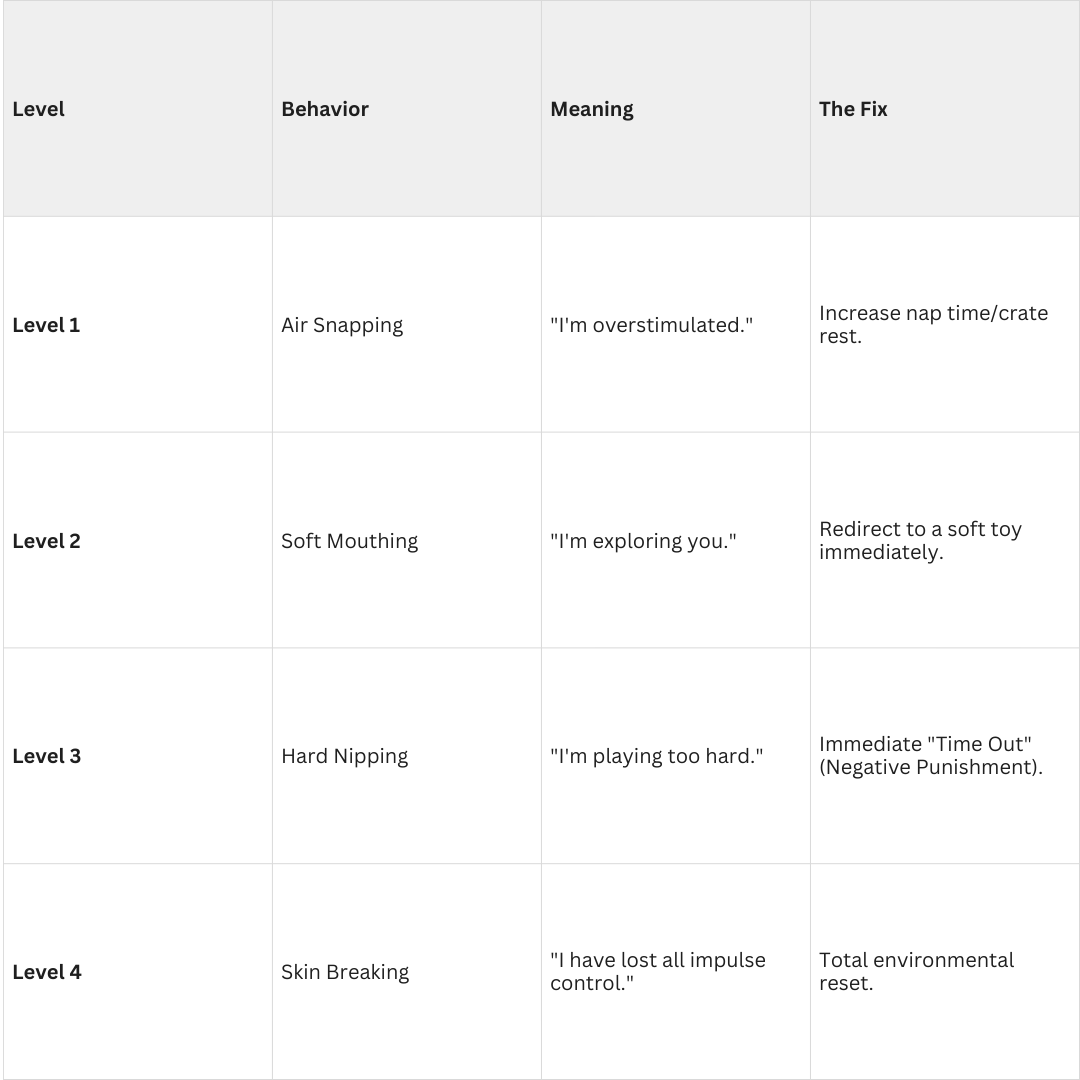
3. Why Common Advice Fails (And What to Do Instead)
You’ve probably heard people say, "Yelp like a puppy so they know it hurts." Stop doing that. For a high-drive Goldendoodle, a high-pitched yelp sounds like a squeaky toy. It doesn't stop them; it activates them.
The Ironstone Three-Step Redirection System
The "Hand Magnet" Reset: If your puppy is nipping, do not pull your hands away quickly (this triggers the "prey drive"). Instead, push slightly toward the puppy or go completely limp.
The Strategic Trade: Never just say "No." Always give them a "Yes." If they bite your skin, offer a textured trade (rubber for teething, plush for comfort).
The Proximity Protocol: If the puppy cannot stop biting, they are likely "over-tired." Just like a human toddler, a "cranky" puppy needs a forced nap in a quiet crate.
4. Essential Tools for the Land Shark Phase
Not all toys are created equal for a Goldendoodle. You need to satisfy different types of "mouth needs."
For Pain Relief: Frozen washcloths or rubber rings (chilled).
For Mental Fatigue: Puzzles and "licking" mats. (A licking dog cannot be a biting dog).
For Texture Satisfaction: Natural fibers (hemp or cotton ropes) to clean the teeth while they chew.
5. When to Seek Professional Help
While the Land Shark phase is normal, you should look for these "Red Flags" that indicate it might be more than just puppy play:
Snarling with lip curling.
Stiffening of the body when touched.
Biting when you approach their food or high-value toys.
If you see these, it’s time to move beyond blog posts and into a structured curriculum.
Master the Mouth: Join the Academy
Understanding the Land Shark phase is the first step, but executing the training is where most owners struggle.
Inside the Ironstone Goldendoodle Academy, I have dedicated a full module to the "Doodle Land Shark." I show you the exact hand movements, the "Time Out" structures, and the redirection flows that I use with my own puppies to ensure they grow into gentle, soft-mouthed adults.
Final Verdict for the Reader
The Land Shark phase is temporary, but the habits you build now are permanent. Don't let your puppy learn that biting is a way to get your attention. Use the systems above, stay consistent, and remember: A tired puppy is a good puppy, but a mentally stimulated puppy is a genius.